
Submersible vs. Surface Pump: Which One Your Irrigation Actually Needs
"I need a pump for irrigation" is like saying "I need a tool to fix the house" — it depends entirely on what problem you actually have. A submersible pump, a surface pump, and a diaphragm booster pump solve three completely different things, and buying the wrong one means either overspending or staying short on pressure anyway.
First: where is the water coming from, and where does it need to go?
That question alone answers 80% of the decision:
- Do you need to pull water out of a well, cistern, sump, or flooded basement and move it elsewhere? That's drainage/extraction — a submersible pump.
- Does water already reach you through the mains, but there isn't enough pressure for several sprinklers to run at once? That's constant pressure — a surface pump.
- Is it just one hose or one watering point that's weak, while the rest of the house is fine? That's a localized problem — a lightweight booster pump, not the other two.
Submersible pump: moving water, not pressurizing it
It sits literally submerged in the water it needs to move — a well, a cistern, a tank. Its job is to pull that water out and push it to another point (a hose, an elevated tank, the rest of the system). It isn't built to hold constant pressure across a sprinkler network — once the water reaches its destination, its job is done.
The AQUASTRONG Submersible Pump 1 HP (4,500 GPH) in this ranking is exactly that: built for drainage and extraction, not for pressurizing sprinklers. If your plan is to feed a drip or sprinkler irrigation system directly with it, you'll likely come up short on sustained pressure — that's what the next option is for.
Surface pump: constant pressure for the whole system
It sits outside the water source (hence "surface"), draws from it, and pushes with constant pressure across the whole irrigation network. This is what you need when your municipal or well pressure isn't enough for two or three sprinklers to run at once without each one losing force.
The AQUASTRONG Self-Priming Surface Pump 1.5 HP in this ranking is built specifically for this — cast iron housing, self-priming (no need to manually fill it with water before every start), marketed specifically for lawn sprinklers. It's notably more expensive than the submersible ($349 vs. $59) and the booster — before buying it, measure your actual line pressure with a cheap gauge at the spigot. If you're at 40-50 PSI and several open sprinklers lose pressure together, that's where this pump pays for itself. If your pressure is already fine, you're paying to solve a problem you don't have.
Diaphragm booster pump: the middle ground almost nobody mentions
This is the option almost nobody brings up because it's less known than the other two: it's lightweight, portable, and instead of pressurizing the whole system, it boosts pressure on a single hose or watering point. It starts and stops on its own via a built-in pressure switch — open the tap and it starts, close it and it shuts off.
The ECO-WORTHY 33-Series Diaphragm Booster Pump (4.0 GPM, 50 PSI) in this ranking comes with garden hose adapters included and runs off a standard 110V outlet — no fixed installation required like the other two. It makes sense if the problem is "this one hose is weak," not "the whole system is weak."
Quick decision table
| Your situation | Pump you need | |---|---| | Pulling water out of a well/cistern/basement to somewhere else | Submersible | | Several sprinklers lose pressure when used together | Surface | | Only one hose or point has weak pressure | Diaphragm booster | | You need both to move water AND pressurize from a distant source | Submersible to move it + surface to pressurize it (two pumps, not one) |
A common mistake: overbuying "just in case"
The 1.5 HP surface pump isn't "better" than the booster just because it's bigger and pricier — if your problem is one weak hose, the booster solves the exact same thing for a third of the price and no fixed installation. Buying the bigger one "just in case" is money that doesn't come back if it ends up with capacity you'll never use.
Our pick this month
Check the full Pumps ranking to compare current prices. If you also need to automate when irrigation kicks in once pressure is sorted, the WiFi Controllers catalog and the guide to choosing a WiFi irrigation controller are the logical next step.
Frequently asked questions
Can I use a submersible pump to pressurize sprinklers? Technically water will come out, but you won't get constant, sustained pressure if several sprinklers run at once — that's not what it's designed for. That's what a surface pump is for.
Does a surface pump need to stay primed all the time? If it's self-priming (like the one in this ranking), no — it primes itself on startup. Non-self-priming ones do need you to manually fill the housing with water before every start, which is a real hassle if you use it often.
Does the diaphragm booster work for the whole yard? No — it's built for one point or hose, not for pressurizing a full sprinkler network. If you try to use it for that, you'll come up short on flow.
Related products
See full ranking →
AQUASTRONG 1 HP Submersible Pump — 4,500 GPH
This is a drainage/removal pump (built to empty pools, basements, or wells), not a constant-pressure pump for sprinklers. It works well for lifting water from a cistern or well into the rest of the system, but if you need steady, sustained pressure for several sprinklers running at once, the surface pump below is better suited for that.
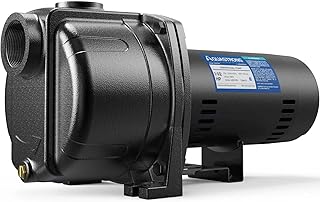
AQUASTRONG 1.5 HP Self-Priming Surface Pump
A centrifugal/jet surface pump, self-priming with a cast-iron body, specifically marketed for lawn sprinklers and garden irrigation — unlike the submersible pump above, it's built to deliver constant pressure, not just move water from one point to another. It's noticeably more expensive; it makes sense if your system genuinely needs extra pressure (check your mains pressure first before investing here).

ECO-WORTHY 33-Series — 4.0 GPM 50 PSI Diaphragm Booster Pump
A diaphragm pump (not centrifugal like the surface pump in this ranking) — it starts and stops on its own via a built-in pressure switch, on demand. Unlike the submersible (drainage) and self-priming surface pump (constant pressure for multiple sprinklers), this is a lightweight, portable booster for a single hose or low-pressure watering point: 4.0 GPM, 50 PSI, 110V AC. It includes garden hose adapters.